Craft lenses
Your prose, seen clearly
Ten reading lenses that wash your own habits onto the page — the adverbs you lean on, the filter verbs that hold the reader at arm's length, the sentences that all run the same length. Each one teaches from both sides and lets you decide. The analysis is the page itself; it never rewrites a word.
Ten lenses
Habits, washed onto the page
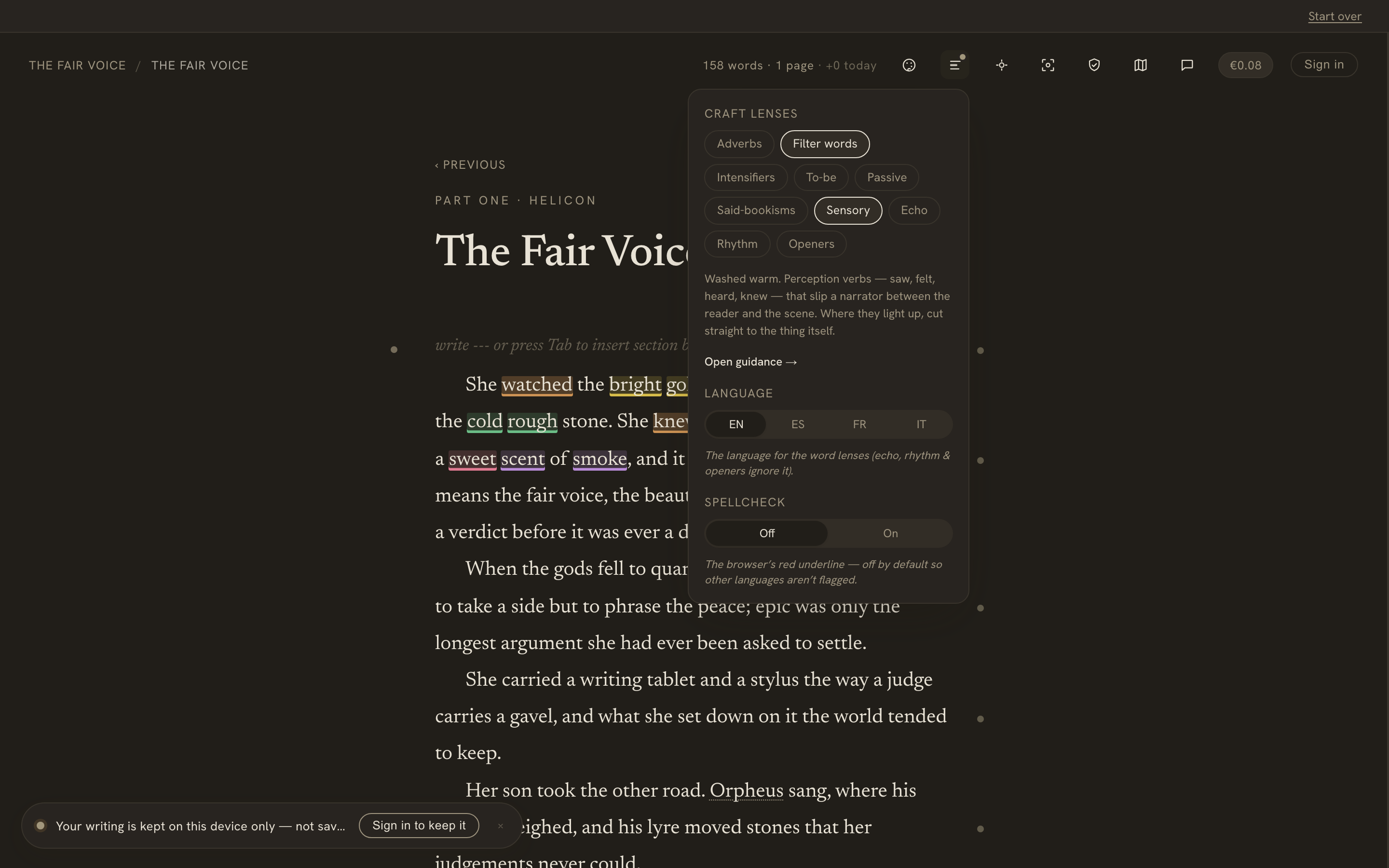
Open the Analysis control and pick from ten lenses: adverbs, filter words, intensifiers, to-be verbs, passive voice, said-bookisms, sensory words, echoes, sentence rhythm, and repeated openers. Turn one on and it colours the manuscript itself — the analysis is the page, not a report in a side panel.
Stack a few at once, and switch the language for the word lenses: English, Spanish, French, and Italian come built in, and a Custom option learns any other tongue — Slovak, a dialect, a conlang — from your own book, so the AI writes the dictionary once and the lenses read it forever.
It teaches, it never grades
Both sides of every rule
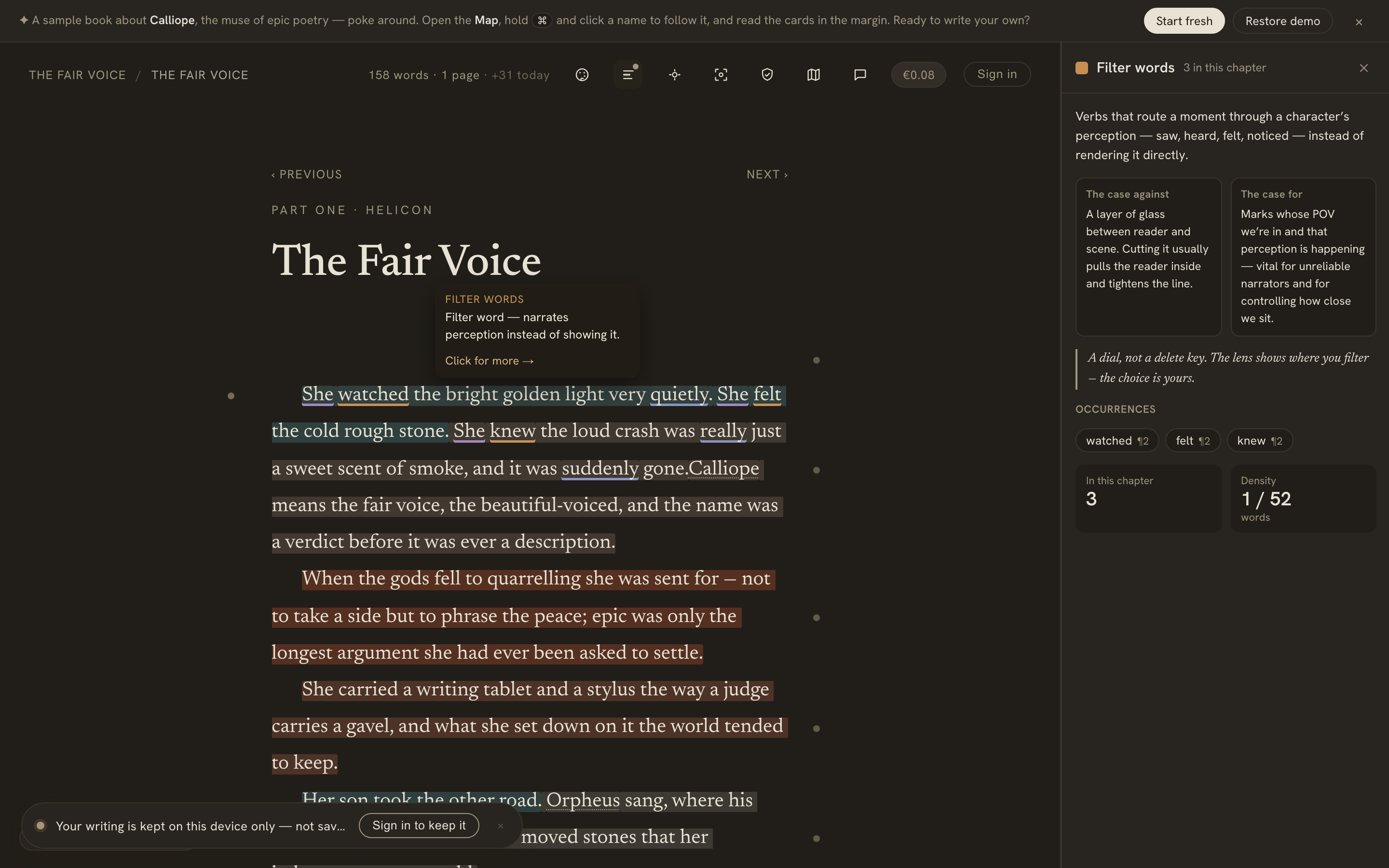
Hover a lit word for the one-line why; click it and a calm sidebar opens with the case against the habit, the case for it, and a takeaway — because every one of these "rules" is a live craft debate, not a verdict. Beneath sit every occurrence in the chapter (click to jump) and a quiet count.
There's no score and no "fix this." The lens shows you the pattern; whether to keep it or break it on purpose stays your call.
Structure, not vocabulary
The shape of your sentences
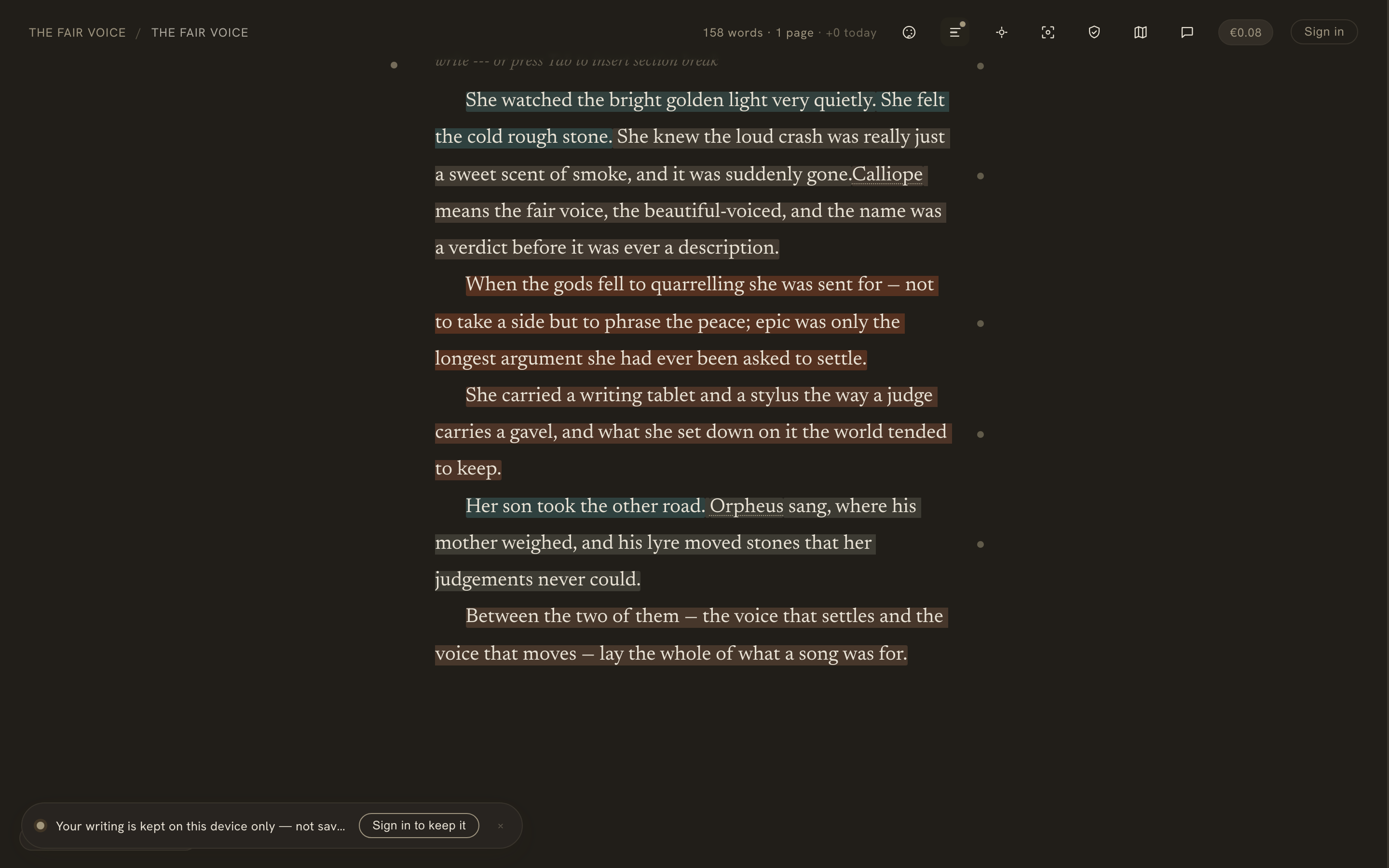
The Rhythm lens tints every sentence by its length on a continuous cool-to-warm scale — a long block of one colour is monotony creeping in; a jagged mix is prose that breathes. Openers flags two or more sentences in a row that start on the same word.
Both read structure rather than words, so they work in any language — no lexicon required.
Awareness, not fault
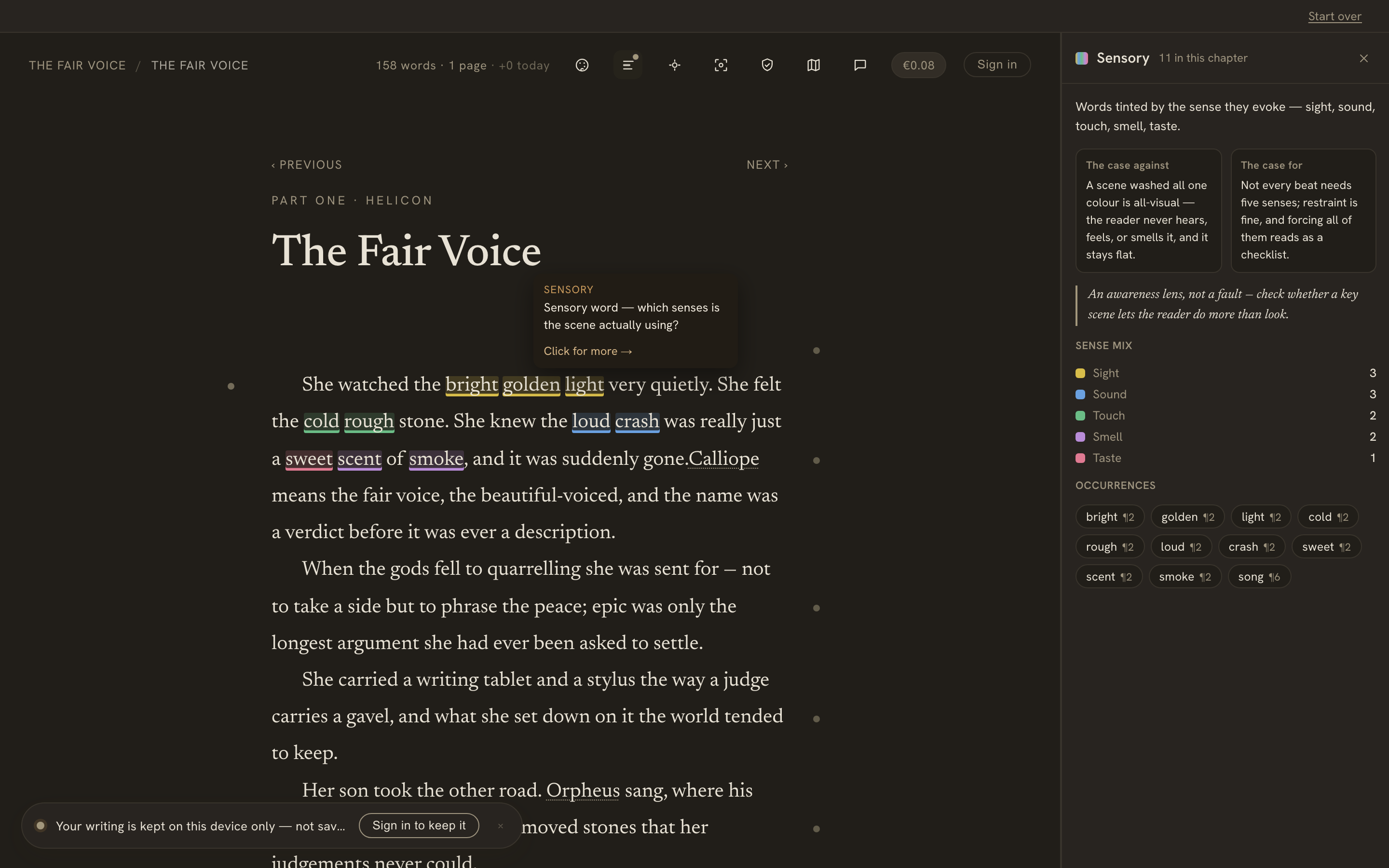
Which senses is the scene using?
The Sensory lens tints each word by the sense it evokes — sight, sound, touch, smell, taste — and the sidebar tallies the mix. A scene lit only in one colour is all-visual: the reader never hears or feels it. Not a mistake to fix, just something worth seeing.
Alongside it: intensifiers that prop up a weaker word, static to-be and passive constructions, and said-bookisms — each with the same two-sided guidance.
Explore the rest of Calliope
All features →Write
Distraction-free editing
Real book typography, warm paper themes, dark mode, focus mode, and typewriter scroll — a surface built to disappear so the page is the only thing you see.
Feel
Ambience
An opt-in, reactive backdrop for the page — a constellation that grows as you finish sentences, an aurora that deepens as you write. Subtle, peripheral, and off unless you want it.
Reflect
Writing stats
Your habit and your book, given back as a calm stats page — a year heatmap, a forgiving streak, your writing persona, the cast of your story, and a shareable Writing Wrapped. It never shames a slow week.
Remember
The Map & structure
The canon of your world — characters, places, facts, every mention — and the outline of your manuscript: parts, chapters, synopses, statuses, reordering.
Think
Marginalia & the AI companion
Notes, to-dos, and chat pinned to the paragraph they're about — beside an AI that reads your whole book, checks it against your canon, and never writes a line of it.
Research
Research beside the page
Ask a question mid-sentence and the companion searches the web, reads the sources, and answers with citations — right in the margin, without pulling you out of the draft. It hands you facts, never prose.
Connect
The MCP connector
Point Claude, ChatGPT, or Cursor at your real book — with a public catalog of editor, critique, character, and craft-drill skills. It reads everything; it never writes your prose.
Automate
The Writer API
Your book as data you can script against — import a legacy manuscript, run a transform, wire a publish pipeline. The one surface where your own prose can flow in and out.
A mirror, not an editor
It shows; you decide
Every lens only recolours prose you already wrote — never a rewrite, never a grade, never a red squiggle of shame. Turn it off and the page is exactly as you left it. The habits are yours to keep or break on purpose; the pen stays yours.
Start writing — free