A story bible whose job is checking your writing, not replacing it
Calliope's Map holds your canon — every character, place, and fact — so your own prose can be measured against it. It exists to keep your story straight, never to ghostwrite the next scene.
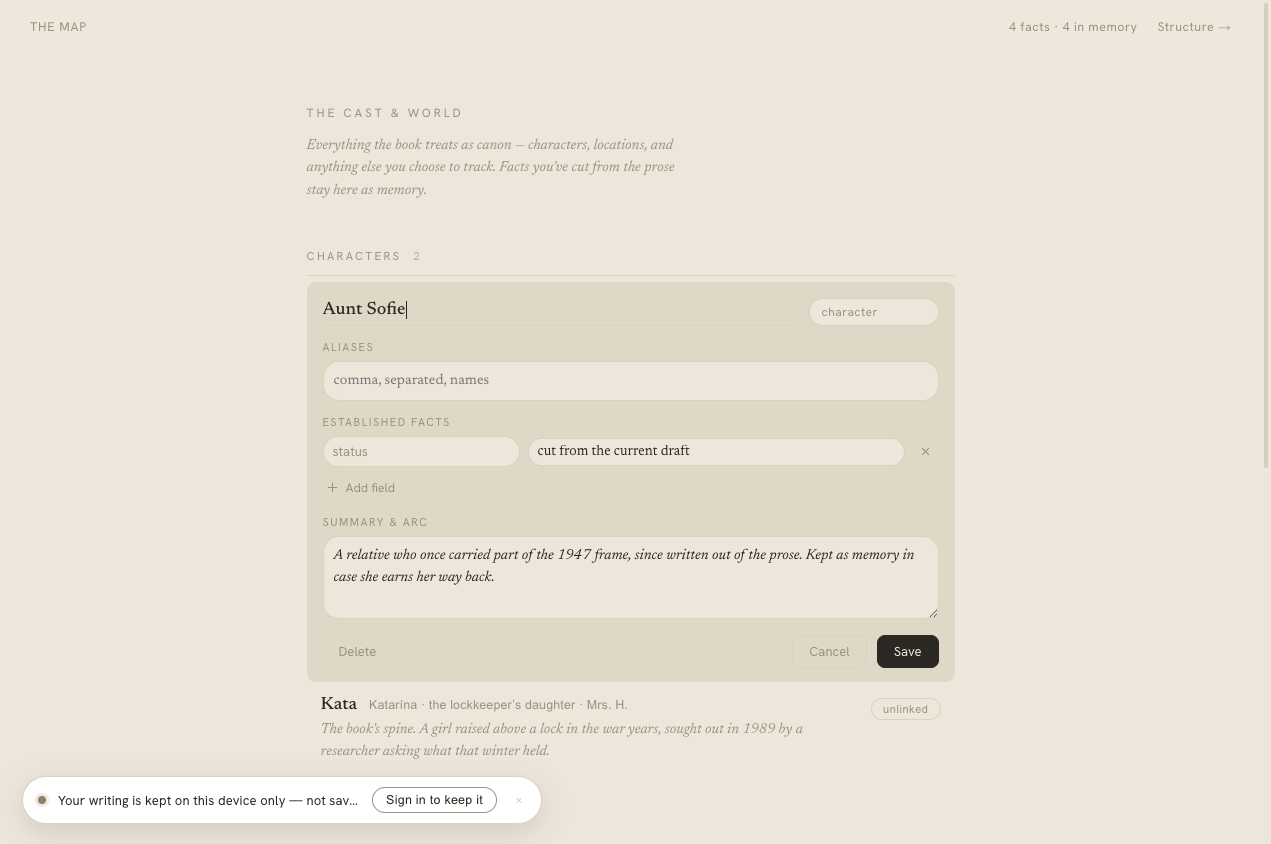
The Map — everything your book treats as canon. Cut a character (like Thalia here) and the fact stays as memory, in case you need it back.
Most “story bible” software exists to feed a machine. You fill in a character database so a generator has something to draw on when it writes the next chapter for you — the bible is fuel for an AI’s prose. That’s the wrong job if you are the one writing.
Calliope’s story bible — the Map — does the opposite. It’s canon you own, used to keep your writing consistent with itself. It never writes a scene.
What a fact is
The Map is built from facts — author-owned entity records, one per thing that matters in your book. A character, a location, an object, a faction, an event, a concept: each is a fact with the same shape.
- A name — what the entity is called.
- Aliases — every other way it shows up in your prose (Katarína, Kata, Mrs. H.).
- Structured attributes — the concrete details, as plain key/value pairs (
eye colour: green,home: the lockkeeper's cottage). - A summary or arc — who they are and where they’re going, in your own words.
Kind is open. Character and Location come seeded as defaults, but objects, factions, events, and concepts share the identical shape — your character database and your world bible live in one place, on equal footing.
Building the bible — two straightforward paths
You build the story bible the way it suits the work in front of you.
- By hand. Create and edit any fact directly. Name it, list its aliases, fill in the attributes you care about, write its summary. Nothing is required; nothing is generated behind your back.
- AI-proposed, you approve. Trigger an entity scan on a chapter and Calliope reads your prose, then proposes facts and the places they’re mentioned. It resolves variants — “Kata”, “Katarína”, “Mrs. H.” — to one entity. Every proposal lands in a review queue where you accept, edit, or reject it. Nothing enters canon unblessed.
The detection reads what you wrote; it never adds to it. The bible only ever fills with facts you’ve approved.
Dedup and merge — for when the same person shows up twice
A growing character database drifts. You write “Kata” for ten chapters, then formally introduce “Katarína Veldhuis”, and now your bible holds two records for one woman.
Find duplicates surfaces likely matches across the whole cast — semantically, so it catches “Kata” ≈ “Katarína Veldhuis” even when the names barely overlap. One click merges them: aliases, attributes, and mentions fold together, and you choose which record survives. It never auto-merges. Two distinct characters who happen to share a name stay separate — a shared name is a label, not an error.
Memory — cut the character, keep the fact
Cut a character out of the manuscript and the prose is gone, but the fact survives in the Map as memory — an orphaned record, set aside rather than deleted. The work you put into that story bible entry is still there if the character walks back into the book three drafts later. Your canon outlives your cuts.
Go to definition — a living map, not a static document
A story bible is only useful if it’s reachable from where you write. Calliope’s Map is a living index, not a document you keep flipping back to.
Hold ⌘/Ctrl and the recognised names in your prose quietly light up; ⌘/Ctrl-click one and you jump straight to its Map entry — go to definition, the way a developer jumps to a symbol. Recognition is computed from the Map’s names and aliases on the fly, so it survives deleting and retyping a name. The bible and the prose stay in step without you maintaining a single link by hand.
Why “checking, not replacing” is the whole point
Every part of this story bible software points the same way. The character database is yours to author. The AI proposes facts from your prose and never past your approval. Dedup suggests, you decide. Memory keeps what you cut. Go-to-definition keeps the canon a click away while you write.
It’s a story bible whose job is checking your writing — keeping your own canon straight — not replacing it. The Map holds what’s true so your prose can be measured against it. It never writes your story for you.
The writing is yours. Keep it that way.
Calliope is story bible software whose canon exists to keep your human prose consistent — not to feed an AI that writes your scenes.
Start for free