AI for fiction writers who still want to write the book
Calliope holds your canon, checks your prose for drift, and researches beside you — then gets out of the way so the words on the page stay yours.
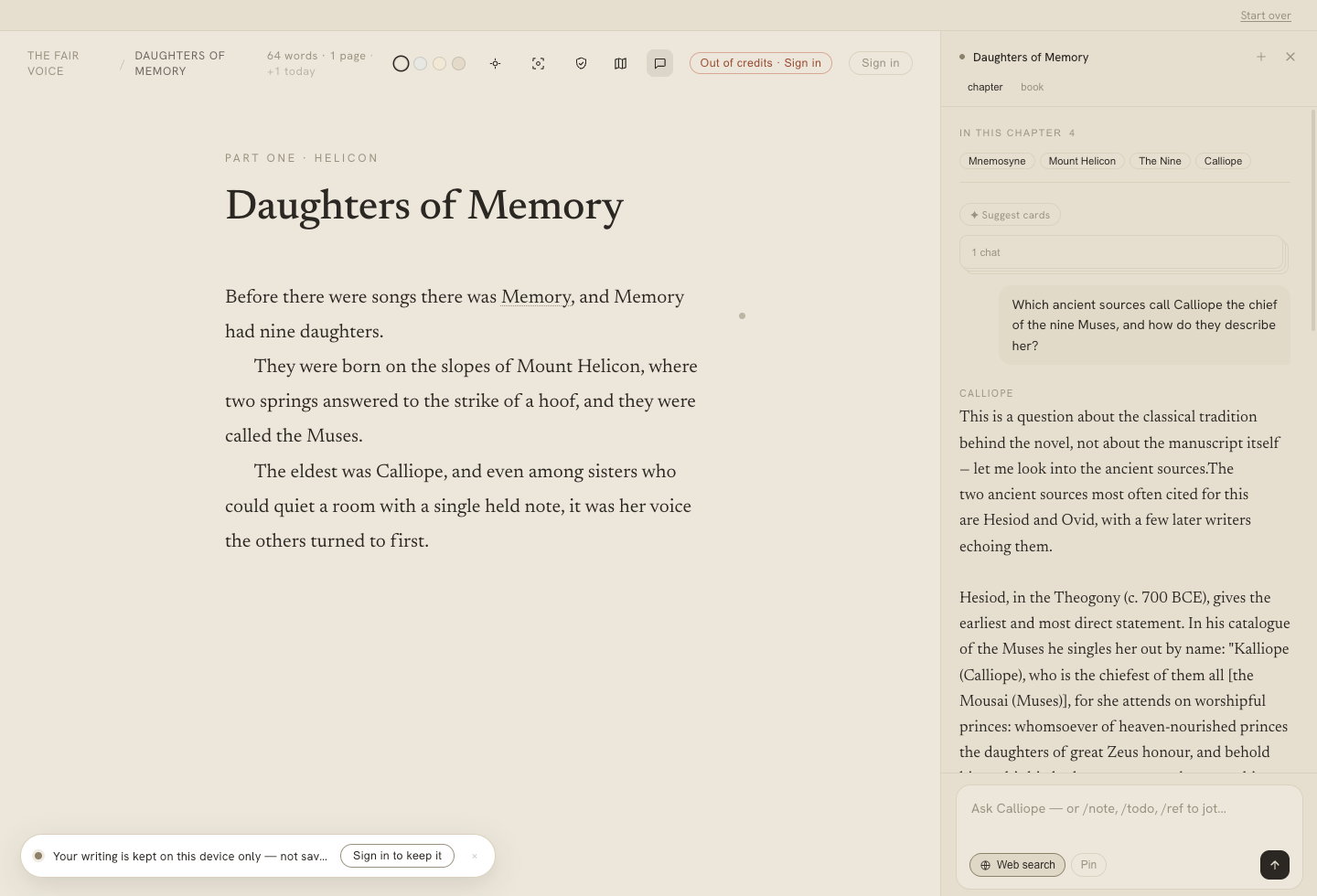
Ask Calliope to research beside your page — real web search with sources — without leaving the chapter, and without it writing a word for you.
Writing a novel means holding an enormous amount in your head at once. Every character and where their arc stands. The locations, the dates, what’s been established as canon and what you quietly changed. Eighty thousand words in, you’re still tracking all of it — and researching the bits you don’t know — while trying to write the next good sentence.
Most “AI for fiction writers” tools answer this by writing the book for you. That isn’t what a serious novelist wants. You don’t need a machine to draft your scene; you need it to carry the weight you were never meant to hold in working memory.
That’s the job Calliope takes.
What Calliope remembers so you don’t have to
As you write, Calliope builds a canon from your own text — author-owned, never invented:
- Characters and their aliases — the woman you introduced as Katarína, started calling Kata, and once referred to only as “she.”
- Established facts — the things your book treats as true, including details you’ve cut from the prose but still need to remember.
- Events and established facts — the things your book treats as true, including details you’ve cut from the prose but still need.
- Locations and the small specifics that a reader will notice if they shift.
You review every entity it detects — accept, edit, or reject each one — and you decide what’s canon. It’s your story. You hold the pen on what’s true.
Consistency checking aimed at your prose
Calliope’s consistency check points at your manuscript, not at an AI’s output. It reads what you actually wrote and flags where it drifts from your own canon:
- The character you renamed halfway through, who a reader won’t recognise as the same person.
- The date in chapter three that no longer lines up with chapter nine.
- The fact you stated confidently once and contradicted later without noticing.
Nothing is auto-corrected behind your back. It surfaces the drift; you make the call — before a reader, or an editor, ever catches it.
Research beside you, not in another tab
The questions a novel raises — how a war ended, what a street looked like in 1947, whether a detail holds up — get answered in a panel beside your draft, scoped to the chapter you’re in. You research without leaving the page and without breaking the spell of the work.
Think a scene through out loud
When a scene won’t hold together, you can talk it through with the AI — what a character would do, where the tension should sit, what you’ve already said about this person. It’s a thinking partner for the hard parts. It will reason with you. It will not write the paragraph for you.
A calm place to actually write
All of this lives inside a distraction-free editor — your manuscript on the page in clean serif type, your canon held quietly in the margins, the AI as calm marginalia rather than a cockpit of buttons. And when you’re ready, Calliope exports the finished book — free — to DOCX (standard manuscript format for agents and publishers), EPUB for self-publishing, a typeset PDF, or a Google Doc.
It never ghostwrites
This is the line Calliope will not cross. It does the remembering, the research, and the consistency work. It never drafts, expands, or rewrites your sentences. AI for fiction writers usually means AI writes the fiction — here it means the opposite, on purpose.
You finish a draft that is unambiguously yours: written with help, not by a machine. If that’s the kind of help you’ve been looking for, Calliope is the tool built for exactly this writer — the one who wants AI to carry the weight, and keep its hands off the words.
The writing is yours. Keep it that way.
Calliope is AI for fiction writers that does the remembering and consistency work but never writes the prose for you.
Start for free